
Emerging Data Analytics Trends in Digital Marketing
There have been plenty of changes in marketing analytics over the past few years, but the current state represents a fundamental shift in how organizations leverage data strategically. With advances in AI, the movement towards privacy, and shifting user behaviours, organizations are rethinking how they generate and apply marketing insights. This article explores the trends shaping digital marketing analytics and how businesses can adapt for strategic advantage.
A Priority on Privacy
When I started working in marketing analytics, privacy was primarily a compliance conversation. These days it's evolved into much more than that, particularly for organizations where trust directly impacts relationship development.
First-Party Data Strategy
After years of back-and-forth, Google finally ended the saga: in April 2025 it confirmed third-party cookies are staying in Chrome, with no deprecation and no user-choice prompt, and by late 2025 it had retired most of the Privacy Sandbox APIs that were meant to replace them. Cookies survived, but the years of uncertainty did their job — forward-thinking organizations have decisively shifted toward privacy-centric approaches anyway.
Digital marketing is gravitating toward first-party data. Why? It delivers better results, is more accurate, enables easier compliance, and improved ROI. With marketers worried about low cookie consent rates eating away at their data, many are leaning heavily on zero-party data, information customers willingly share instead of data inferred from their behaviour.
Consent Management
Google's consent mode has become something of an industry standard, translating user preferences into adjustable tracking parameters without tanking campaign performance. Even if you're not specifically targeting European users, implementing a consent management platform still delivers value, such as improved analytics by capturing data from all visitors globally, improved ad performance because platforms like Google and Meta use complete data sets to optimize campaigns across all regions, and stronger customer trust. A practical approach I've seen work well is configuring CMPs to automatically grant consent for North American users while requiring explicit opt-in for users from regions with stricter privacy laws.
For organizations navigating complex partner ecosystems, Data Clean Rooms (DCRs), secure environments that let partners analyze shared data without exposing raw customer information, are becoming essential infrastructure. These secure environments enable collaboration between organizations without exchanging raw customer data, preserving privacy while still providing joint insights.
Self-Service Analytics
Self-service analytics puts intuitive dashboards and natural-language querying in the hands of marketers, reducing ad-hoc IT requests and accelerating decision-making. According to the 15th edition of the Dresner Wisdom of Crowds Self-Service BI study (2026), end-user self-service remains critical to BI success for organizations of all sizes.
Platforms like Looker, Tableau, Power BI, and Domo are well integrated with accessible point and click reporting, letting marketing teams easily analyze spend, attribution, and funnel data to make faster decisions, better cross-team alignment, and reduced data team backlogs.
Server-Side Tracking
The technical foundation of marketing analytics has undergone a quiet transformation. Server-side tracking architectures are increasingly adopted in enterprise marketing stacks due to their ability to bypass privacy mechanisms at the browser layer, enhance compliance with evolving privacy regulations, and significantly improve data accuracy and reliability.
Unified Data Collection
By processing data through secure environments before routing it to analytics platforms, organizations reduce reliance on vulnerable client-side scripts. This approach also facilitates compliance with regulations like GDPR and CCPA.
Businesses are quickly deferring to server-side tracking solutions like server GTM containers and conversions API gateways. However, this shift brings higher data processing costs due to increased demand for servers and storage. It's forcing organizations to get much smarter about optimizing their data pipeline efficiency.
Server-side tracking with Google Tag Manager enables analytics tags from websites and apps, providing a more complete view of the customer journey. For organizations with complex multi-channel strategies, this approach enhances data accuracy and integrity.
Cross-Environment Measurement: Real-Time & Offline Data Integration
Real-time analytics is becoming standard for organizations that want to bridge the gap between event and action, and respond quickly to customer behaviour. Customer data platforms like Adobe CDP connect live web or app events with offline transaction enabling timely personalization.
Technical challenges persist in cross-device identification, particularly for app-to-web journeys. Google's enhanced conversions API addresses this by using hashed first-party identifiers to stitch sessions across environments while maintaining SHA-256 encryption standards.
The data import options in GA4 and Google Ads helps link in-store purchases to user IDs, closing attribution gaps that digital tracking alone may not be able to address. Google Ads offline conversion import now requires the conversion_environment parameter to differentiate app from web conversions, reflecting the increasing sophistication of cross-environment tracking requirements.
Combining real-time data with offline insights gives marketers a clearer, more complete view of the customer journey and help ensure the right budget decisions are made.
The Next Era of Marketing Analytics
The conversation around AI in marketing analytics has shifted from speculative potential to more practical application. For organizations managing complex user journeys, this advancement offers tangible opportunities to enhance decision-making and customer understanding.
Automation in Analytics
Automation is fast becoming the operational backbone of marketing analytics. According to a McKinsey report, generative AI-driven automation can boost marketing productivity by 5–15% of total spend, translating into billions of dollars in annual value. Deloitte's 2026 TMT Predictions suggest as many as three-quarters of companies will be investing in agentic AI by the end of 2026 — though far fewer have autonomous agents actually running in production. The shift from rule-based workflows to self-optimizing data pipelines is real, just slower than the headlines imply. Gartner highlights that automation now spans data ingestion, cleansing, and anomaly detection, freeing analysts to focus on interpretation and strategy rather than routine data wrangling.
The evolving analytics ecosystem is making these capabilities accessible to teams of all sizes. GA4’s automated insights surface predictive alerts directly within daily workflows, while Adobe's AI Assistant in Customer Journey Analytics (the successor to its Sensei-era tooling) layers AI models onto raw data, helping marketers uncover actionable insights about their customers.
The outcome is a shorter path from data to decision, better governance, and a more direct link between analytics and revenue impact.
Predictive Intelligence
The integration of generative AI with traditional predictive models, particularly Marketing Mix Models and propensity modeling, represents a significant advancement for marketing teams seeking deeper insights into attribution and influence.
Enhanced machine learning capabilities are transforming analytics approaches. The widely-used open-source Python library scikit-learn is being made more accessible for machine learning tasks in marketing. NVIDIA's cuML is a game-changer, enabling zero-code-change GPU acceleration for scikit-learn applications. What does this actually mean? Marketers can now rapidly process large datasets, optimize predictive models, and gain faster insights without needing deep technical expertise.
Unstructured Data
Unstructured data, such as customer interactions and support conversations, has often been underutilized in marketing. AI has transformed this by enabling advanced analytics in areas like conversational intelligence, content performance, and competitive analysis.
Democratizing Data Access
Google's Conversational Analytics in Looker, now generally available and powered by Gemini, and Microsoft's Copilot use AI to make data analysis more accessible. Users can ask questions in natural language and get insights without needing to code, write queries, or formulas.
This lowers the technical barrier for exploring complex datasets and brings data-driven decision-making to more people across an organization.
Synthetic Data
Synthetic data helps marketers innovate faster by enabling precise audience targeting and effective testing, providing affordable, high-quality insights for market research and strategy development. At the same time, it also protects privacy, meets regulatory standards, and keeps sensitive information secure, making it especially valuable for industries that handle confidential data.
Emotional Analytics Making Sentiment a First-Class Data Signal
Emotional analytics uses computer vision and speech processing to translate micro-expressions, voice tone and word choice into structured data points. Brands are already pairing these signals with creative optimisation. A legacy denim label cited by Forbes lifted Gen Z engagement by tuning ad sequences in real time based on detected joy and interest, outperforming demographic targeting alone.
Deployment is becoming almost plug-and-play. Affectiva (now part of Smart Eye), Realeyes, Google Cloud Vision, Azure AI Vision and Amazon Rekognition capture facial coding data, vocal sentiment and multimodal scoring.
Marketers can feed these outputs into empathy maps and use them to strengthen loyalty and drive revenue. Of course, ethical guardrails such as opt-in consent, anonymization of raw images, and completing regular bias audits are needed to stay on the right side of both privacy law and public perception.
Zero-Click Discovery
The integration of AI into search and information discovery has fundamentally altered how decision-makers research solutions. Google's AI overviews offer answers directly in search results, reshaping how content is found, trusted, and acted on.
Beyond Search Visibility Metrics
SparkToro's 2026 zero-click study found roughly 68% of US Google searches now end without a click, up from about 60% in 2024 — fewer than one in three searches still sends a visitor to the open web. For complex queries, this figure drops even lower as AI-generated overviews synthesize information directly in search results.
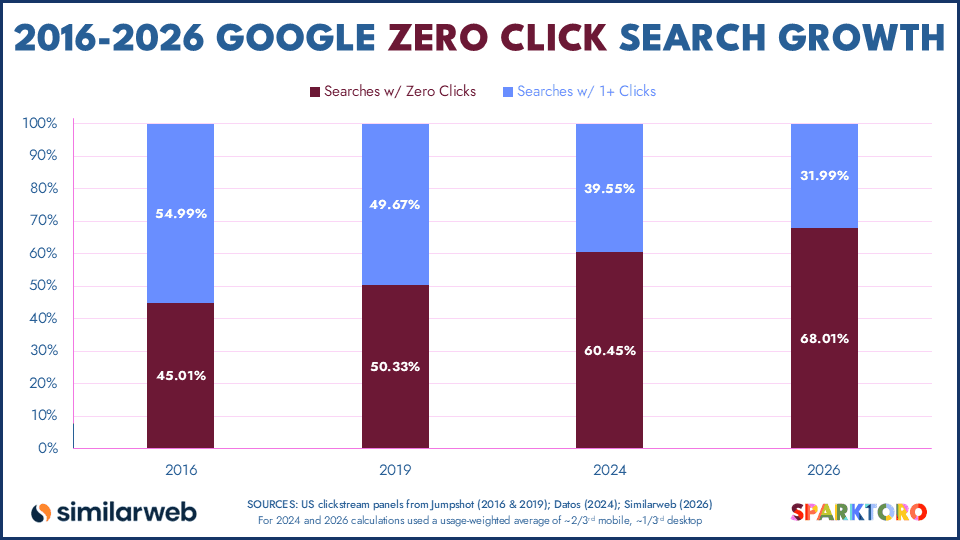
Source: SparkToro, 2026 Zero-Click Search Study
Datos (a Semrush company) tracked Google Search growing 20%+ in 2024, when it handled roughly 373X more searches than ChatGPT. The gap has narrowed considerably since, but the underlying story holds:
- Ahrefs' 2026 analysis puts ChatGPT at about 12% of Google's search volume — yet Google still sends roughly 190X more traffic to websites, because most prompts never produce a click
- A large share of LLM prompts still serve non-search purposes like summarization, drafting, and coding, and ChatGPT use doesn't appear to be cannibalizing Google usage
The trendline is real, but referral traffic still overwhelmingly comes from Google. Keep the AI search buzz in perspective and continue prioritizing your traditional SEO/Google Search strategies alongside the newer channels.
Another study reports that only 6% of AI-generated overviews include exact search queries, signaling a shift toward understanding intent rather than matching keywords. This shift demands content strategies that address underlying business challenges rather than targeting specific search terms.
Dual-Track Content Approach
New content strategies are beginning to emerge as a result:
- Generative Engine Optimization (GEO): The decoupling of impressions and clicks in organic search has pushed marketing teams to start shaping strategies and content designed to be mentioned in Google's AI Overviews, as well as AI search and answer engines like ChatGPT, Claude, and Perplexity, even if it drives brand mentions instead of traffic. That trade-off has only sharpened: even as AI assistants answer more queries, they send a small fraction of the referral traffic Google does, so visibility inside the answer increasingly is the win.
- Engagement-Focused Resources: High-value content that motivates users to move beyond search results into direct engagement.
These approaches acknowledges the changing nature of content discovery while creating multiple pathways for meaningful connection in a zero-click environment.
Advanced Attribution and Budget Optimization
The rise of omnichannel touchpoints has pushed the need for advanced attribution frameworks. Google's Meridian (an open-source marketing mix model) offers a scalable way to understand the true impact of media spend. By combining aggregated data, Bayesian inference, and customizable modeling, Meridian helps marketers allocate budgets more effectively across channels while accounting for external factors and long-term influence.
Predictive Budget Allocation
Machine learning now informs real-time bidding strategies through continuous scenario modeling. Google's demand forecasts combines seasonal trends with real-time inventory data to predict category-level search demand up to 90 days in advance. Early adopters in the travel sector have seen significant reductions in cost-per-acquisition by shifting budgets to anticipated high-demand periods.
These systems require robust data infrastructure. The average enterprise marketing team now maintains numerous distinct data sources, processes terabytes of data monthly, and requires almost instantaneous latency for real-time bidding feeds, technical requirements that were pretty much unimaginable just a few years ago.
The Importance of Testing
Despite the advanced analytics capabilities now available, a lot of organizations don't have structured testing or data maintenance programs. Which is a missed opportunity to ensure data accuracy and integrity.
Building Testing Frameworks
If you're trying to stay ahead, having a solid testing framework can make a huge difference. It helps tackle common challenges like:
- Long sales cycles: You don’t always have time to wait for every conversion, solid testing can give you useful signals early
- Small audiences: Develop methods to get clear answers from limited data
- Lots of decision-makers: Testing should reflect how complex buying decisions really happen
From what I’ve seen, the marketing teams that put structured testing in place move faster, make more informed decisions, and set themselves up for long term success.
Ethical Data Practices
As AI capabilities advance, ethical considerations have moved from theoretical discussions to practical requirements. However, it seems consumer distrust remains a critical barrier, with many still expressing concern about AI manipulation.
AI With Human Oversight
Balancing AI capabilities with human judgment is crucial, especially in areas where relationships and context are key to success. This balance ensures that AI enhances human decision-making without replacing the nuanced understanding that humans bring to complex situations.
Research has suggested that purely AI-driven approaches underperform human-AI partnerships in complex scenarios. This finding underscores the continued importance of domain expertise alongside advanced analytical capabilities.
Sustainable AI Practices
Although there are still issues with hallucination, marketing teams are going to continue using AI to help analyze data and drive strategy. However, ethical concerns over large language models ranging from privacy to bias have driven the rise of more efficient, transparent alternatives. Open-weight models like Meta's Llama, Google Gemma, DeepSeek, Qwen, and Mistral's small models are gaining traction for offering strong performance with greater control and flexibility. These models are readily available on platforms like Hugging Face and can be deployed in your own cloud environment on BigQuery ML or Azure. Or better yet, run locally on your device using applications like LM Studio or Ollama for secure, scalable use.
Looking Forward: Integrated Intelligence
Success in marketing analytics will require the thoughtful integration of advanced capabilities with strategic vision and domain expertise. The global data analytics market, projected to surpass $150 billion in 2026, represents both the scale of investment and the strategic importance of these capabilities.
For marketing leaders, the path forward involves purposeful technology adoption, structured testing frameworks, and a commitment to both analytical rigor and contextual understanding. Organizations that successfully implement server-side tracking, invest in first-party data infrastructure, and adopt transparent AI practices are positioned to achieve substantially higher ROI compared to laggards.
By embracing this balanced approach, organizations can transform marketing analytics from a technical function into a genuine competitive advantage in an increasingly complex space.